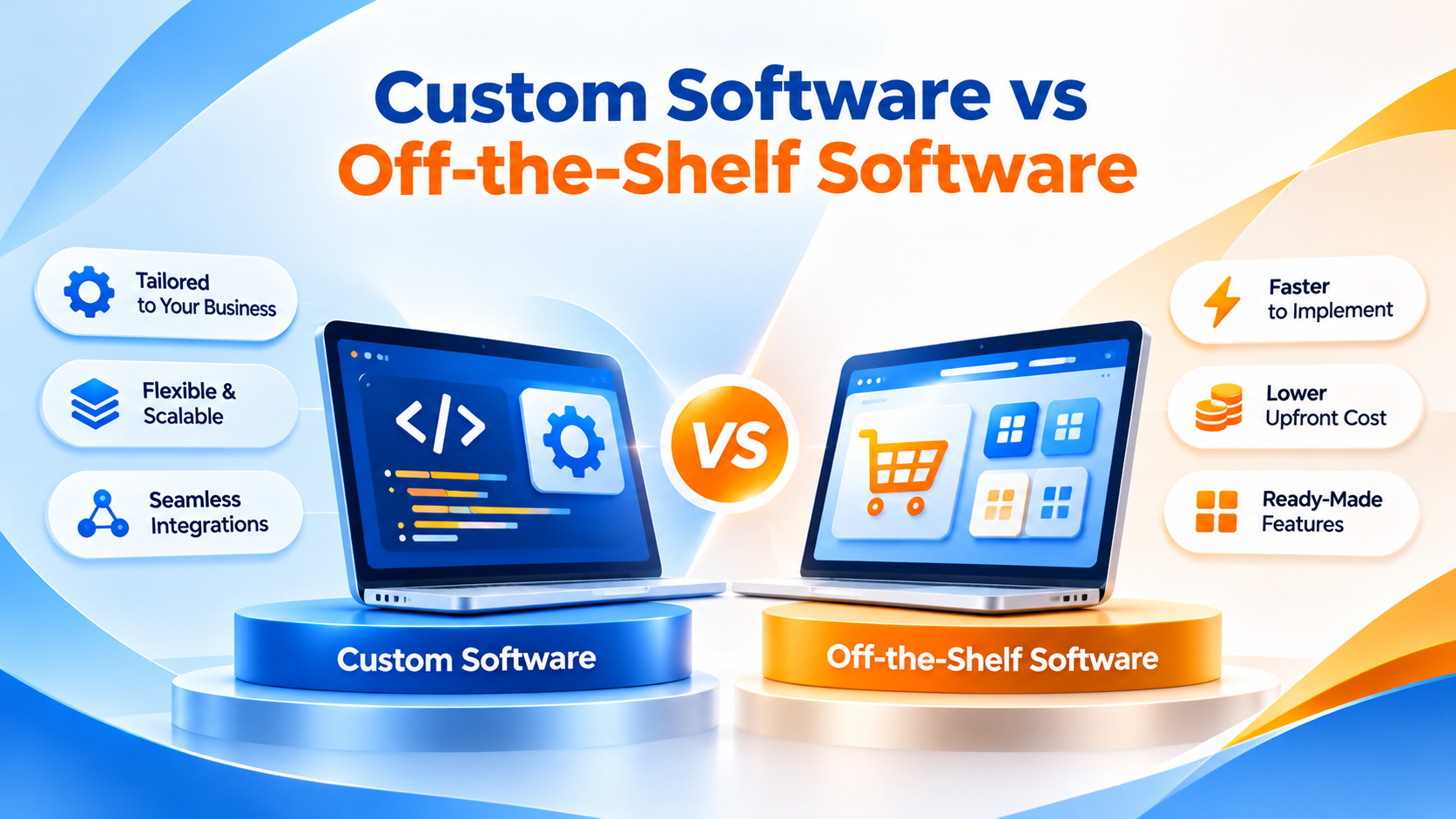
Custom Software vs Off-the-Shelf Software: Which Is Right for Your Business?
Custom Software Development is becoming an important consideration for businesses that want technology to support their specific workflows rather than force their teams to work around software limitations. But does every company need a custom-built solution? Not necessarily. For many businesses, off-the-shelf software can be a practical and cost-effective choice.
The Multi-App Disconnect in Retail
Imagine running a growing retail business in Dubai. Your team uses one application for sales, another for inventory, and a separate spreadsheet for reporting. As your operations expand, moving information between these systems becomes increasingly difficult.
You have two options: invest in ready-made software that covers most of your requirements or develop a solution designed around your business processes. Both approaches have advantages. The right choice depends on your budget, operational complexity, integration requirements, and long-term goals.
What Is Custom Software?
Custom software is an application designed and developed to meet the specific requirements of a business or organization. Unlike ready-made products, custom applications are built around defined workflows, user roles, business rules, and integration needs.
For example, a property management company may require a single platform to handle tenant records, lease agreements, maintenance requests, rent tracking, and management reporting. A generic application might cover some functions, but a custom solution can connect them according to the company’s operating model.
Key Advantages of Custom Software
Businesses exploring this approach can learn more about Neutonsoft’s custom software development services.
What Is Off-the-Shelf Software?
Off-the-Shelf Software refers to ready-made applications developed for a broad group of users or businesses. These products typically include predefined features and are available through subscriptions, licenses, or one-time purchases.
Examples include standard accounting applications, customer relationship management platforms, HR systems, and project management tools. Because the core product already exists, businesses can often begin using it more quickly than a completely custom-built application.
Key Advantages of Off-the-Shelf Software
Ready-made software can also mean limited customization, paying for unused features, and relying on the vendor for updates or integrations. For straightforward requirements, these trade-offs may be acceptable.
Custom Software vs Off-the-Shelf Software: Key Differences
The biggest difference is flexibility. Custom software is developed around specific requirements, while off-the-shelf software provides standardized capabilities.
Comparing Custom Software vs Off-the-Shelf: Finding the Right Balance for Your Business
| Factor | Custom software | Off-the-shelf software |
|---|---|---|
| Functionality | Specific requirements tailored to your exact workflows | Predefined features built for broad market needs |
| Initial investment | Generally higher upfront engineering investment | Often lower initial license or setup cost |
| Implementation | Depends on project scope, design, and testing | Usually faster with pre-packaged setup |
| Customization | Extensive flexibility across UI, logic, and database | Vendor-limited configuration and fixed parameters |
| Scalability | Architected for specific growth and load patterns | Depends on subscription tier and vendor infrastructure |
| Integrations | Purpose-built connections and custom API bridges | Restricted to supported APIs and pre-built connectors |
| Maintenance | Agreed support approach and controlled releases | Typically vendor-managed with shared release cycles |
| Control | Greater IP, source code, and data ownership control | Vendor-dependent with proprietary vendor boundaries |
1. Cost: Initial Investment vs Long-Term Value
Off-the-shelf solutions usually require a smaller initial investment because the application already exists. Custom software generally requires more upfront investment for planning, design, development, testing, and deployment. However, initial cost does not tell the whole story.
Over time, ready-made software may involve user licenses, premium modules, integration costs, and recurring subscriptions. Custom software may involve hosting, maintenance, security updates, and ongoing development.
Key Cost Factors to Evaluate
TCO Horizon
Compare total cost of ownership (TCO) over a three to five-year period rather than choosing solely by the initial price tag.
2. Customization: Does the Software Fit Your Workflow?
Every business has its own way of operating. Even companies in the same industry may follow different approval processes, reporting structures, or customer management workflows.
With off-the-shelf software, businesses generally configure available features to match their needs. Custom software offers more flexibility when requirements are highly specific.
For example, a UAE recruitment company may need to connect candidate sourcing, client approvals, interview scheduling, placement tracking, and commission calculations. If these processes involve unusual rules, Custom Software Solutions may be more suitable than disconnected applications.
3. Scalability: Will Your Software Support Future Growth?
A business with one location may eventually expand to several branches. A startup serving a small customer base may need to support substantially more users. Both custom and off-the-shelf solutions can scale, but differently.
Ready-made software usually scales according to the vendor’s plans and architecture. Custom software can be designed with specific expansion requirements, although scalability still depends on sound engineering.
Questions to Evaluate Growth Capacity
4. Integrations: Connecting Your Business Systems
Modern businesses rarely operate through a single application. Retailers may use billing, inventory, accounting, and e-commerce platforms; service businesses may depend on CRM, customer support, and reporting tools.
When systems do not communicate, employees transfer information manually. Off-the-shelf products may offer integrations or APIs, while custom applications can be designed for specific interfaces and workflows.
This is where Business Software Development can help reduce repetitive work and improve data consistency. Organizations exploring intelligent automation can also review Neutonsoft’s AI and Machine Learning Services.
5. Maintenance, Security, and Software Ownership
With off-the-shelf applications, vendors generally manage updates and bug fixes, while customers remain responsible for their own configurations, access permissions, and data. For custom software, maintenance responsibilities depend on the development agreement and operating model.
Neither approach is inherently more secure. Security depends on application design, infrastructure, access controls, updates, and monitoring. The OWASP Application Security Verification Standard is a useful reference for application security requirements.
Businesses commissioning custom applications should clarify source-code access, intellectual property rights, licensing, documentation, and maintenance responsibilities in contracts.
When Should You Choose Custom Software Development?
Custom Software Development may be the better approach when standard applications cannot support your requirements without significant compromises.
Signs You Need Custom Software
A real estate business managing multiple builders, projects, sales teams, and customer interactions may benefit from Custom Business Applications reflecting its particular processes. Custom development should still begin with clear requirements, scope, budget, and maintenance expectations.
When Is Off-the-Shelf Software the Better Choice?
Ready-made software is often practical when requirements are common and a suitable product already exists.
Signs Off-the-Shelf Is Right
For example, a small business seeking basic attendance tracking may not need a completely custom HR platform. Evaluate licensing terms, support, data portability, and integration limitations before purchasing.
Is a Hybrid Approach Possible?
Yes. Businesses can combine an existing application with custom-built functionality. A company might use a standard CRM while developing a specialized customer portal or reporting dashboard connected to it.
This can reduce the amount of software built from scratch while addressing unique requirements. Evaluate integration capabilities, licensing restrictions, and long-term maintenance before choosing this model.
How to Choose the Right Software for Your Business: 6 Steps
Identify the Problem
Define what the software must improve: eliminating manual reporting, consolidating scattered customer records, or resolving unsupported operational bottlenecks.
Separate Essential and Optional Features
List must-have requirements separately from useful but nonessential features to establish an accurate Minimum Viable Product (MVP) scope.
Evaluate Available Products
Check whether existing packaged software supports your processes through standard features, configuration, or pre-built integrations.
Estimate Total Cost of Ownership
Compare full 3-to-5 year development, licensing, subscription, customization, maintenance, training, and expansion expenses.
Consider Long-Term Requirements
Plan for anticipated growth in user count, branch locations, transaction volumes, and future third-party integrations.
Consult a Development Partner
Assess whether a ready-made, custom, or hybrid approach best fits the business with an experienced technology partner.
How Neutonsoft Helps Businesses Build the Right Software
At Neutonsoft, we understand that different businesses require different technology approaches. A growing retailer, property management company, and logistics provider may all need software, but their workflows and operational challenges are rarely identical.
Our software development services focus on understanding business requirements and translating them into practical digital solutions. Depending on the project, this may include:
Tailored Software Capabilities
Businesses in Dubai, Abu Dhabi, Sharjah, and other UAE markets can explore Neutonsoft’s software development services to discuss their project needs.
Frequently Asked Questions
Frequently Asked Questions
Conclusion: Choose Software That Works for Your Business
The choice between custom software and off-the-shelf software depends on what your business needs today and how those requirements may evolve. Ready-made software offers convenience and faster implementation; custom software offers flexibility for specialized processes, complex integrations, and long-term technology requirements.
Neither option is universally better. For businesses whose needs cannot be addressed effectively by standard applications, Custom Software Development can provide a practical path toward a tailored digital environment.
Your Business Is Unique. Your Software Can Be Too.
At Neutonsoft, we help businesses turn operational challenges into practical software solutions. Whether you are planning a new application, modernizing an existing platform, or connecting disconnected systems, our team can help you explore the right approach.
Build software around your business — not the other way around.
Website: neutonsoft.com